
Brand


Marlboro Cigarettes: History, Flavour Profiles, Nicotine and Tar in Australia

Marlboro cigarettes are the world’s best-selling cigarette brand, an American-blend filter cigarette that Philip Morris launched in 1924 and that Australians still buy under names most smokers no longer recognise. Philip Morris International owns the brand outside the United States, and no Marlboro is made in Australia today, so every pack here arrives as an import. The brand began as a women’s cigarette and became a global icon through the Marlboro Man. Its core range runs from the toasted, full-flavour Red through the softer Gold to the softest Silver, with menthol as a cooling branch. Red prints the most tar and nicotine of the three.
Australian law has reshaped the Marlboro pack three times, in 2005, 2012, and 2025, and each change altered what a buyer sees on the shelf. A licensed shop now sells Marlboro in plain 20-stick packs under names such as Blended R, and excise makes up more than half of the price. The sections below set Marlboro against the other international brands Australians compare it with, look at what smokers say about it, and explain the rules for buying it legally.
What Are Marlboro Cigarettes?
Marlboro cigarettes are filter cigarettes made with an American blend of tobacco, and they have been the best-selling cigarette brand in the world since 1972. Philip Morris named the brand after Great Marlborough Street in London, where the company opened its first factory. Three companies share it today. Altria sells Marlboro in the United States, Philip Morris International sells it in every other market except Canada, and Philip Morris Limited is the Australian company that imports it. The brand reached a record 11.0% share of the international cigarette market in the fourth quarter of 2025, according to Philip Morris International.
No company legally manufactures cigarettes in Australia today, according to the Australian Taxation Office. Every Marlboro pack sold here is an import and pays customs duty at the border at the same rate as excise. The market each carton was made for prints on the pack, which is why two Marlboro cartons with the same name can carry blends made for different countries. Marlboro is the brand. Red, Gold, Silver, and the menthol lines are its variants.
A Short History of Marlboro
Marlboro began in 1924 as a luxury cigarette that Philip Morris later sold to women, and a 1950s advertising campaign turned it into the most recognised cigarette brand in the world. Six dates trace that change.

| Year | What happened |
|---|---|
| 1924 | Philip Morris launches Marlboro in the United States as a luxury cigarette. |
| 1930s | Advertising positions it as a women’s cigarette under the line “Mild as May”. |
| 1950s | The Leo Burnett agency repositions the brand around the Marlboro Man. |
| 1972 | Marlboro becomes the best-selling cigarette brand in the world. |
| 1974 to 2011 | Marlboro sponsors McLaren in Formula One from 1974 to 1996, then Ferrari as title sponsor from 1997 to 2011. |
| 2008 | Philip Morris International reorganises the brand into three families, Red, Gold, and Fresh. |
The Marlboro Man, a rugged cowboy created by the Leo Burnett agency, became one of the best-known advertising figures of the 20th century and carried the brand into every major market. He also came to stand for the other side of smoking. Several of the men who played him died of smoking-related disease, and public health campaigns have told their stories ever since. The 2008 families still organise the range today, and each one tastes different.
Marlboro Flavour Profiles and Variants
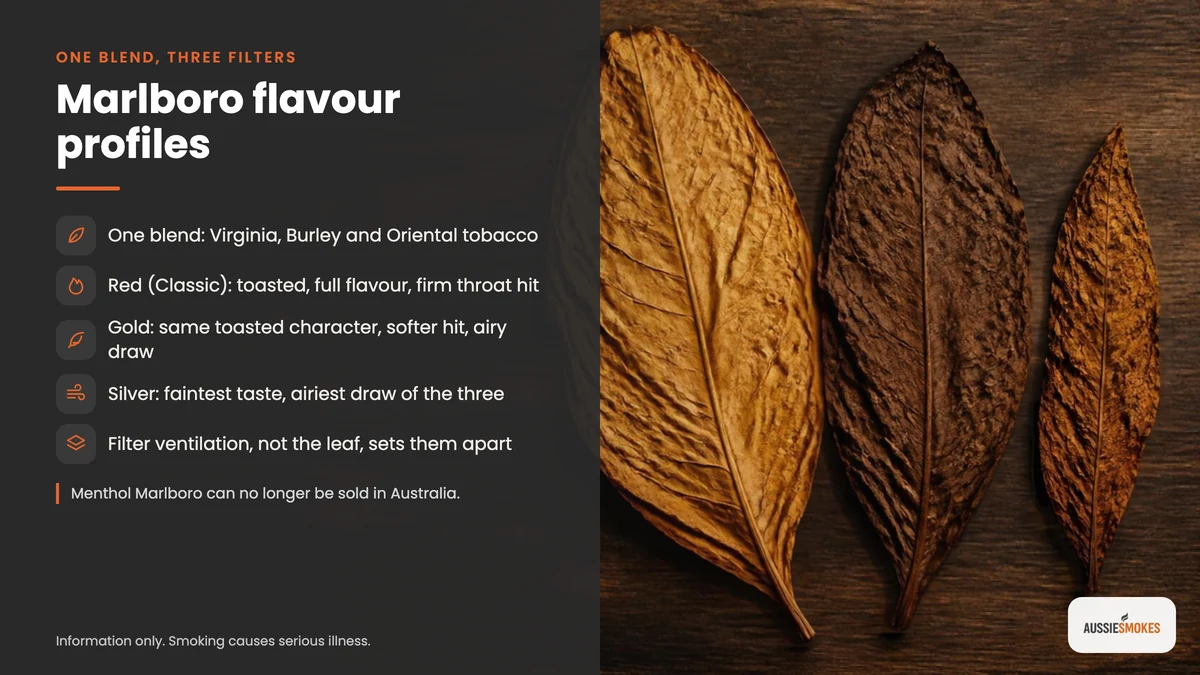
Every core Marlboro starts from the same American blend of Virginia, Burley, and Oriental tobacco. The filter, not the leaf, separates the full-flavour Red from the smoother Gold and the softest Silver, and menthol adds a cooling layer on top. Virginia brings sweetness, Burley brings body, and Oriental brings an aromatic, dry edge. The Marlboro Flavours guide covers what each Marlboro variant tastes like in more depth.
Marlboro Red (Classic)
Marlboro Red is the original Marlboro and the full-flavour benchmark of the range, a toasted, full-bodied cigarette that sets the measure for every other Marlboro.
- Strength: full flavour, the strongest core Marlboro
- Flavour notes: toasted, slightly woody tobacco with a faint caramel-like sweetness at the finish
- Throat hit and body: a firm throat hit and dense smoke from the first draw to the last
- Aftertaste: a tobacco taste that lingers after each draw
Each leaf in the blend adds one part of that taste. Flue-cured Virginia is high in sugar, which gives Red its sweetness without added sugar. Air-cured Burley carries little sugar and supplies the body and the firm hit, and sun-cured Oriental brings the aroma and the dry finish. Red has the least filter ventilation of the core variants, so its smoke reaches the palate least diluted. Marlboro Red USA leaves out the Oriental leaf and tastes drier and more direct. In Australia the red pack disappeared in 2012 and the word Red in 2025, and licensed shops now list the variant as Blended R.
Marlboro Gold (Lights)
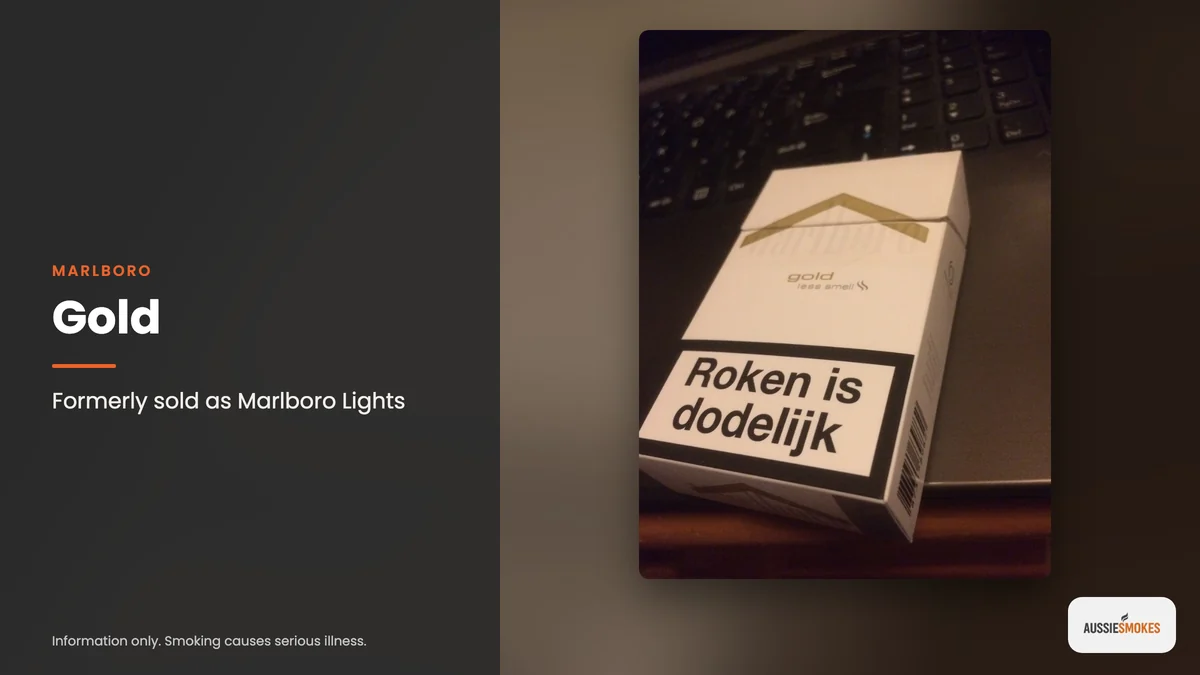
Marlboro Gold is the smoother, softer Marlboro that Australians bought as Marlboro Lights until 2005, with Red’s toasted character at a lower intensity.
- Strength: soft to medium
- Flavour notes: the same toasted Marlboro character with a subtle sweetness and less bitterness than Red
- Throat hit and body: a soft throat hit, a thinner body, and an airy draw
- Aftertaste: short, fading quickly rather than lingering
Gold uses the same three-leaf blend as Red, so why does it taste softer? Its filter carries fine perforations that pull air into each draw and dilute the smoke. Philip Morris sells the Gold family on a smoother taste, and smoother describes the draw, not a lower risk. The ACCC removed the word light from Australian packs from 31 July 2005, and a 2006 court ruling did the same in the United States. Licensed Australian shops now list Gold as Regular G.
Marlboro Silver and Menthol
Marlboro Silver and menthol Marlboro sit at the two edges of the range, Silver as the softest core variant and menthol as the cooling family that Australia banned in 2025.
Marlboro Silver
- Flavour notes: a faint toasted tobacco taste, the Marlboro character at its faintest
- Throat hit and body: very soft, with thin smoke and the airiest draw of the three
- Aftertaste: minimal
Silver carries the most filter ventilation of the core variants, so each draw holds the most air. Australians knew it as Marlboro Ultra Lights until the ACCC undertaking of 2005, and Australian law has banned the colour word silver from packs since 1 July 2025.
Menthol Marlboro
- Flavour notes: cool mint over a medium tobacco base, and capsule versions such as Ice Blast taste like plain tobacco until the smoker crushes the capsule in the filter, then turn cold and minty
- Throat hit: cold and sharp rather than warm
- Aftertaste: minty rather than toasted
Menthol triggers a cold feeling in the mouth and throat and masks the harshness of smoke, according to the Department of Health. Australia’s ban on menthol and crush-ball cigarettes began on 1 April 2025, retailers sold existing stock until 1 July 2025, and no shop in Australia can sell menthol Marlboro now.
Marlboro Nicotine and Tar Levels
Marlboro Red carries the most tar and nicotine of the core Marlboro variants, at around 12 mg of tar and 0.9 to 1.0 mg of nicotine per cigarette on the packs that print them. Gold and Silver step down from there. Tar is the sticky residue a smoking machine traps from the smoke, and nicotine is the addictive substance in tobacco. The machine smokes every cigarette the same way, so the figures let you set one variant against another. Draw harder or cover the filter holes and you take in more than the pack says.
- Marlboro Red (Classic): about 12 mg tar and 0.9 to 1.0 mg nicotine
- Marlboro Gold (Lights): about 7 to 9 mg tar and 0.6 to 0.8 mg nicotine
- Marlboro Silver (Ultra Lights): the lowest figures of the three
The drop from Red to Gold to Silver comes mainly from the filter, since the same blend sits behind more ventilation holes at each step. The numbers also shift by market, so one variant can print different values in different countries. Australian plain packs have printed no tar or nicotine figures since 2005, so these values come from imported packs.
The Department of Health states that no tobacco product or level of smoking is safe, and a lower printed number doesn’t make a Marlboro safer.
Marlboro in Australia: Plain Packaging and Tobacco Law
Australian regulators have reshaped the Marlboro pack three times since 2005, first its variant names, then its colours, and then its names, size, and ingredients again. An ACCC undertaking drove the 2005 change, the Tobacco Plain Packaging Act 2011 the 2012 change, and the Public Health (Tobacco and Other Products) Act 2023 the 2025 change.
2005: Marlboro Lights Became Marlboro Gold
Philip Morris renamed Marlboro Lights as Marlboro Gold in Australia after an ACCC undertaking. The undertaking removed light, mild, and the related tar numbers from every pack made for Australian smokers from 31 July 2005. The ACCC acted because those words suggested a cigarette with lower harm. Marlboro Ultra Lights became Marlboro Silver in the same change. British American Tobacco and Philip Morris paid A$8 million in total under the arrangement to fund anti-smoking information. The change still shows on the shelf, since Australian packs have printed no tar or nicotine figures ever since.
2012: Plain Packaging Took the Colours Off the Pack
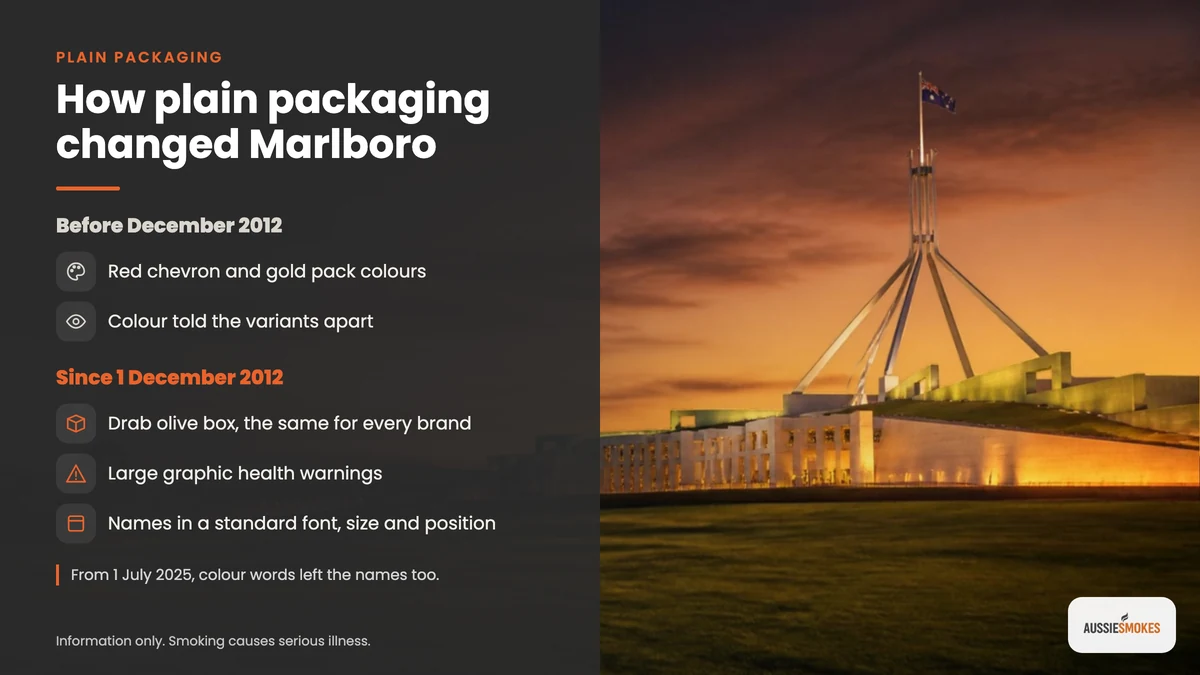
Plain packaging took effect on 1 December 2012 and replaced Marlboro’s red chevron and gold pack with the drab olive box and large graphic health warnings that every brand in Australia carries. The law kept the brand and variant names on the pack, in a standard font, size, and position, so Marlboro Red and Marlboro Gold survived as words. Colour stopped telling the variants apart, and the name became the only signal a buyer had left. The 2025 laws went after that last signal.
2025: New Names, 20-Stick Packs and No Menthol
Australian law has banned colours, gold, smooth, and similar words from cigarette names since 1 July 2025. Licensed shops now sell Marlboro under names such as Blended R, Regular G, and Regular B. The Department of Health lists the terms that are out, which cover words that suggest lower harm, colours, references to the filter, and numerals. The letter in each new name echoes the old pack colour, R for red and G for gold. The same date set every pack at 20 sticks and every carton at 10 packs, as explained in the guide to how many cigarettes are in a packet. Every stick now shares one length and width, and the ban on menthol, other flavours, and crush balls took the menthol family out of licensed shops.
- Blended R: the name licensed retailers list where Marlboro Red used to sit
- Regular G: the name licensed retailers list where Marlboro Gold used to sit
- Regular B: a third Marlboro name on licensed shelves
How Much Do Marlboro Cigarettes Cost in Australia?
A carton of Marlboro costs around A$549 in a licensed Australian shop, about A$2.75 a cigarette, and A$1.55 of every cigarette is federal excise. Imported cartons sold online list for less per stick, and the importer and the seller set that price rather than a shelf price. The table shows prices checked on 23 September 2026.
| Channel | Unit | Price | Price per stick |
|---|---|---|---|
| Licensed shop | carton of 10 packs of 20 | A$549 | A$2.75 |
| Licensed shop | pack of 20, from the carton price | A$54.90 | A$2.75 |
| Online seller, imported | carton of 10 packs of 20 | A$160 to A$250 | A$0.80 to A$1.25 |
Why does a licensed carton cost that much? Excise sets the floor for the licensed shelf. The Australian Taxation Office charges A$1.55274 a stick from 1 September 2026, which adds A$31.05 to every pack of 20, and it indexes the rate each March and September. Prices move twice a year as a result, so every Marlboro price carries a date.
Comparing Marlboro With Other Cigarette Brands
Marlboro differs from Camel, Manchester, Double Happiness, Esse, and Dunhill, the international brands Australians most often weigh it against, in three ways. Blend, stick shape, and home market set the six apart.
Marlboro and Manchester pair sweet Virginia leaf with fuller Burley, and Marlboro adds an aromatic Oriental leaf on top. Camel, the other American brand in the group, builds its blend on Turkish and Virginia leaf. Double Happiness follows the Chinese style of flue-cured Virginia almost on its own, which gives a sweeter, thinner smoke than an American blend.
Esse built its name on slim sticks and gives the airiest draw in the group, while the other four sell mainly in the standard stick that Marlboro uses.
Marlboro and Camel are American brands. Dunhill is British and sits at the premium end, Manchester is a younger Dubai brand with an unusually wide range, Double Happiness is Chinese, and Esse is South Korean. Every one of them arrives in Australia as an import, and Marlboro remains the American-blend, full-flavour reference point in the group.
Public Impressions and Consumer Reviews
Smokers show their view of Marlboro in what they keep buying and what they keep looking up, and both point to a brand people stay with through every change to the pack.
- Loyalty in the numbers: the record market share Marlboro reached in late 2025 shows how many smokers keep choosing it
- Gold has overtaken Red in interest: Australians search for Marlboro Gold more often than Marlboro Red, and the softer variant now draws the wider audience
- Old names stick: smokers in Australia still search for Marlboro Lights two decades after the word left the pack
- Confusion since 2025: on Australian forums, smokers ask which new shelf name matches their old variant, and some say the taste has changed since the 2025 ingredient rules
The Marlboro Man is also one of the most cited cases in tobacco-control history. A purchase in Australia still has to meet the law, whatever a smoker thinks of the brand.
Is It Legal to Buy Marlboro Cigarettes in Australia?
Adults aged 18 and over can legally buy Marlboro cigarettes in Australia from a licensed seller, as long as the product meets the 2025 rules on packs, names, and ingredients. Supermarkets such as Coles and Woolworths, tobacconists, and service stations stock the plain-packed variants, and the guide to licensed tobacco shops in Australia sets out the other places to buy. Every state and territory licenses tobacco sellers, and South Australia bans the sale of tobacco by internet, mail, and telephone. No shop anywhere in the country can sell menthol Marlboro.
A legal Australian Marlboro pack is easy to recognise. It comes in the plain olive box with a large graphic health warning, it holds 20 sticks, and it carries one of the new variant names. Counterfeit and illicit stock gives itself away on price. A pack or carton priced far below the usual online range is usually unbranded or illicit tobacco, not a bargain. Anyone who wants to stop smoking can call Quitline on 13 7848.
Frequently Asked Questions About Marlboro Cigarettes
Two questions remain once the brand, the variants, the strength, the law, and the price are clear.
Is there a nicotine-free Marlboro cigarette?
No Marlboro cigarette is nicotine-free, because every tobacco cigarette contains nicotine. Gold and Silver print lower figures, but they still deliver nicotine with every draw, and the Department of Health notes that all tobacco is addictive. A smoker looking for a nicotine-free option won’t find one in the Marlboro range.
Can you bring Marlboro cigarettes back from overseas?
Each adult traveller can bring 25 cigarettes into Australia duty-free, barely more than one pack. Anything above that allowance pays duty at the border, according to the Australian Border Force, so a carton bought overseas costs far more once it lands. Marlboro cartons are also available from sellers within Australia.
