
Brand


Do Cigarettes Expire? Shelf Life, Stale Signs and Storage
Most cigarette packs do not carry a consumer expiry or best-before date, but tobacco still goes stale. Moisture and flavour fade, and the smoke can taste harsher. WHO-style packaging guidance often steers markets away from printing a smoker use-by date, because that mark can imply the product is safe before the date. Australian plain packs still show a manufacturer packaging date code for traceability, not a best-before for smokers. Figures below are indicative ranges reported by public guides; confirm freshness by smell and feel.
This page covers indicative shelf-life windows for sealed packs, opened packs and cartons; how to spot stale sticks in Australian heat and humidity; and what the local packaging date code actually means, plus FAQ and Quitline.
Do cigarettes expire?
Yes. Cigarettes expire in the everyday sense: the tobacco goes stale and quality falls once moisture and aroma leave the leaf. Smokers usually call that “stale,” not milk-style spoilage, but the pack still has a useful life.
Packs typically do not print a consumer use-by or best-before date. WHO Framework Convention on Tobacco Control (FCTC) Article 11 guidance steers markets away from smoker expiry marks, because a printed date can imply the product is safe to use before that date. Australian plain packs show a manufacturer packaging date code for traceability instead (for example D5 = April 2025), not a best-before for smokers.
Quality still declines without a printed use-by. Public guides usually put sealed, well-stored packs at about 6 to 24 months of acceptable freshness (many cluster near 1 to 2 years). Opened packs often taste off within days to a few weeks. That window shortens with heat, humidity, sunlight and open air, and stretches when the wrap stays sealed and the pack stays indoors out of the sun. Full ranges sit in the table below.
How long do cigarettes last?
Guides disagree on exact months, but they agree on the pattern: sealed packs last longest, opened packs stale fastest, and heat or humidity shortens every window.
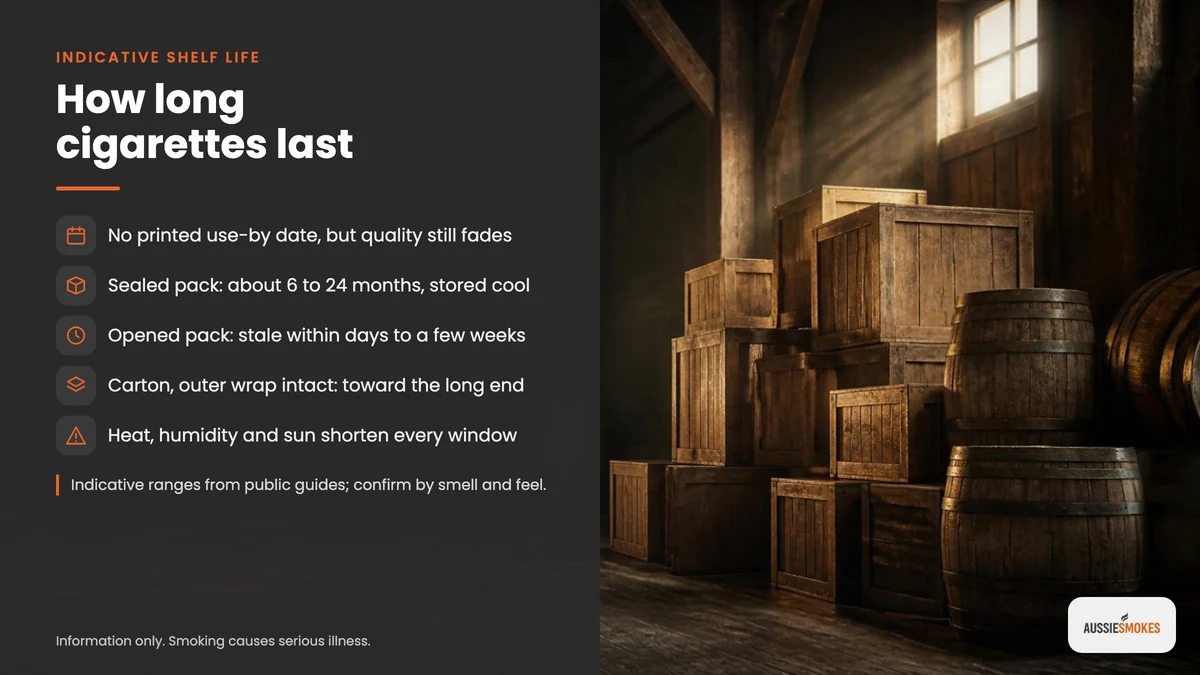
These figures are indicative ranges reported by public guides, not Australian laboratory shelf-life data. Climate and how you store the pack matter more than the calendar.
| Condition | Indicative freshness window (from guides) |
|---|---|
| Unopened / sealed pack | About 6 to 24 months when stored cool and out of the sun |
| Opened pack | Noticeable staleness often within days to a few weeks |
| Carton / factory-sealed multipack | Often toward the long end of unopened ranges if outer wrap is intact |
Menthol or capsule products may lose character sooner per some commercial notes. Buy quantities you will finish, and rotate older sealed stock first. Confirm the pack by smell and feel before you assume the month count still holds.
How to tell if cigarettes have gone bad
Smell, pinch, look and burn behaviour show a stale pack without a printed expiry date.
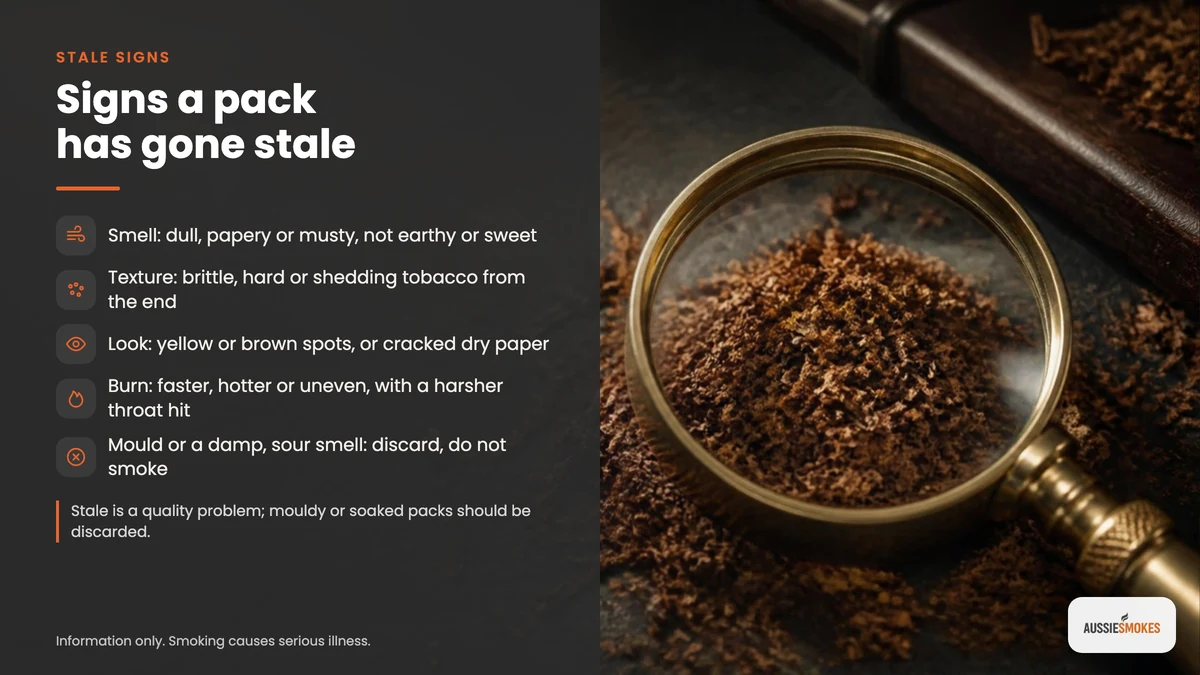
The following 6 signs mark tobacco that has gone bad:
- Smell: Fresh tobacco smells earthy or sweet, or minty if menthol. WikiHow and Canada Smokes describe stale sticks as dull, papery or musty.
- Taste / mouth feel (unlit): WikiHow notes a bitter or sharp note instead of the usual tobacco taste.
- Texture: A fresh stick has a slight spring. WikiHow and AussieFact describe stale sticks as brittle or hard, or shedding tobacco from the end.
- Appearance: Yellow or brown spots on the paper, or cracked dry paper, mark age and drying.
- Burn: Canada Smokes and Cigarette Express link stale packs to faster, hotter or uneven burn and a harsher throat hit.
- Mould or damp/sour chemical odours: Canada Smokes and AussieFact treat fuzzy white, blue or green spots, or a damp/sour chemical smell, as a discard decision. Do not smoke.
Unpleasant stale sticks are a quality problem. Mouldy or soaked packs are a discard decision.
How to store cigarettes to keep them fresher?
In Australia, heat, sun and humidity ruin packs faster than the calendar. A sealed pack in a cool indoor spot beats a glovebox.
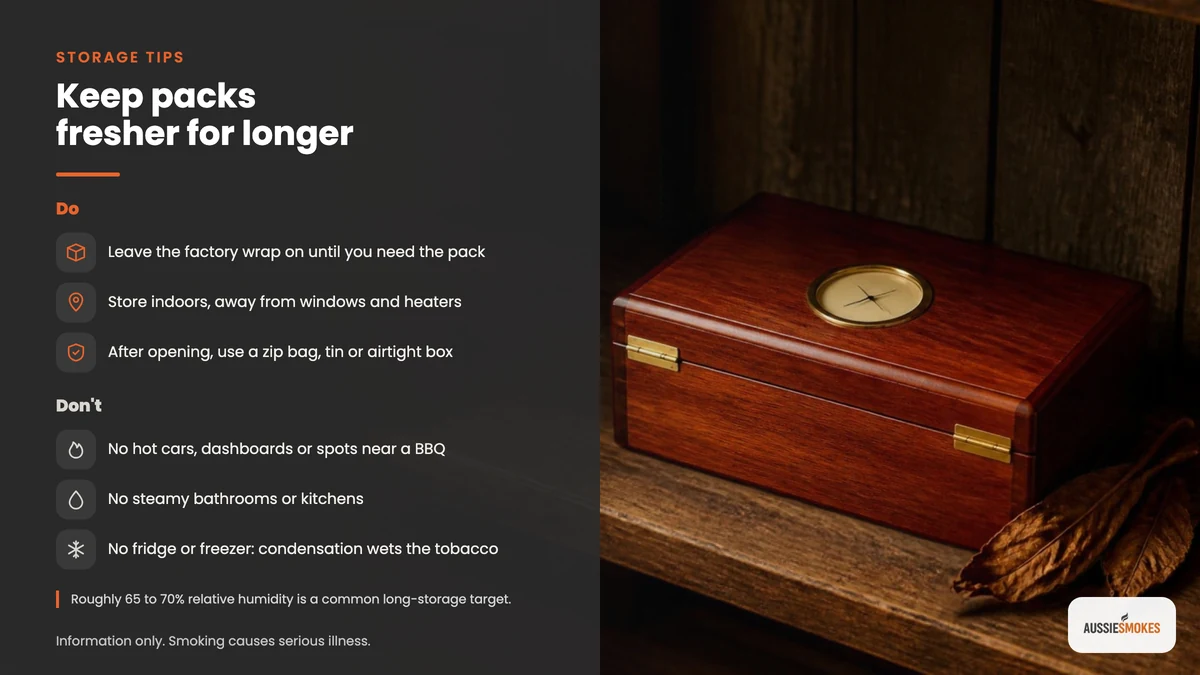
Do
- Leave the factory wrap on until you need the pack. Store indoors in a drawer or cabinet away from windows and heaters.
- After opening, limit air exposure with a zip bag, tin, or airtight box around the pack.
- For bulk sealed stock, rotate oldest first; keep cartons flat and out of the sun.
- Optional for longer sealed stashes: a small airtight container, and where useful a humidity pack marketed for tobacco. A basic sealed tin is enough.
Don’t
- Leave packs in a hot car, on a dashboard, near a BBQ, or in bathrooms and kitchens with steam.
- Put packs in the fridge or freezer. Condensation when the pack warms wet paper and tobacco. Cool room storage away from heat and sun is the practical rule.
AU climate callout: Hot car cabins, humid coastal air and dry inland heat all shorten freshness. Indoor, sealed, and out of direct sun is the baseline.
Tobacco stores best in a moderate humidity band. Roughly 65 to 70% relative humidity is a common long-storage target. Too dry makes sticks brittle and harsh. Too wet risks sogginess or mold. Treat that band as storage hygiene, not a lab prescription for every Australian home.
Are stale cigarettes more harmful?
Stale cigarettes are usually a worse experience, not a safer one. Freshness does not make smoking safe.
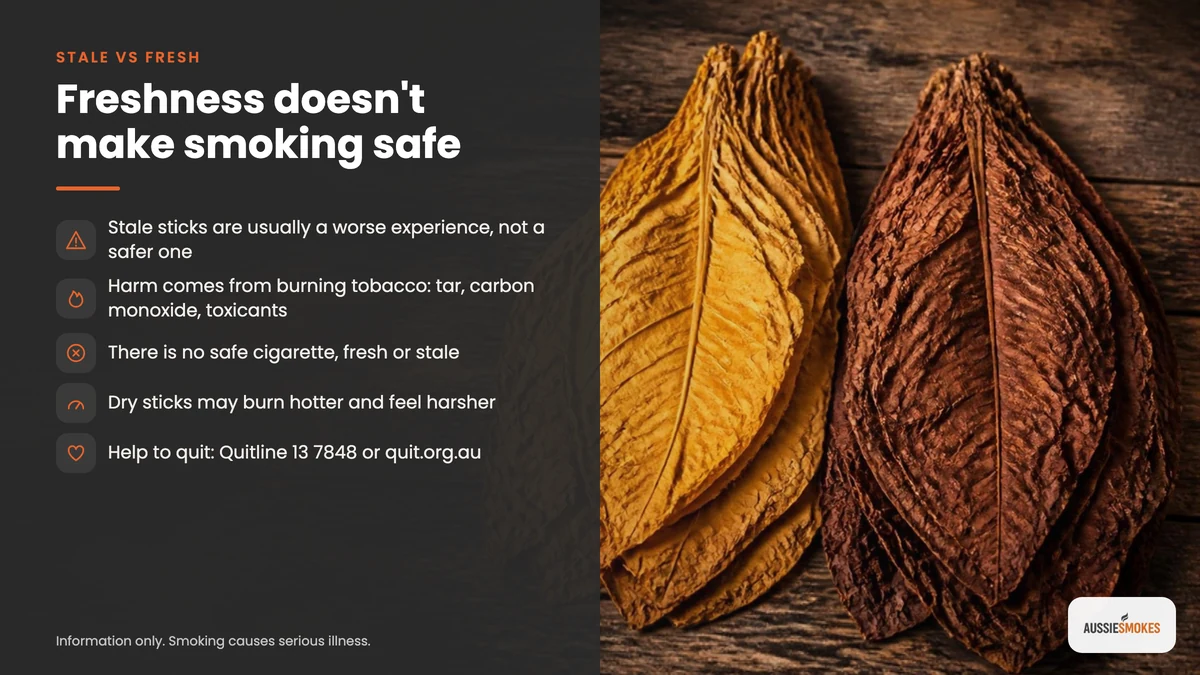
Core harm comes from burning tobacco (tar, carbon monoxide and other toxicants), not from whether the pack is a week or a year old. Public health framing (including American Cancer Society material on whether any smoking is safe) is clear: there is no safe cigarette. Stale or dry sticks may burn hotter or faster and feel harsher; some smokers report more throat irritation (commercial guides and AussieFact).
An Open Respiratory Archives letter discusses quality deterioration with poor storage or age and possible increased harmful effects, while also noting WHO opposition to printing expiry that implies pre-date safety. Read that cautiously: it supports worry about poor-quality aged products, not a green light that “fresh equals low risk”.
Mouldy or contaminated product: do not smoke; discard. The healthiest choice is not to smoke at all; see the Quitline section below.
FAQ
How long do cigarettes last after opening?
Often days to a few weeks before noticeable staleness; reseal and keep the pack away from heat to slow it. WikiHow and Canada Smokes describe flavour loss within a few days; other guides stretch toward a few weeks. Reports vary, so trust the smell and feel. See the opened-pack row in the table above.
What does the date code on an Australian pack mean?
It is a manufacturer packaging date mark (for example D5 = April 2025). The letter is the month (A to L) and the digit is the year ending. It records when the product was packed for compliance and traceability; it is not a smoker use-by date (Health.gov.au packaging guide; TIA 12.9). Full decode sits in the AU packs section above.
Can you smoke 2-year-old cigarettes?
They may still light, but quality is often poor (dry, flat, harsh). Mouldy packs should be discarded. Smoking remains harmful either way. Sealed storage away from heat is what some guides assume when they cite up to about two years for cartons; hot Australian conditions can cut that short. Check the stale-signs checklist before deciding.
Should you refrigerate or freeze cigarettes?
Generally no: condensation can damage paper and tobacco. Prefer cool room storage away from heat and sun. WikiHow mentions fridge or freezer tips; Cigarette Express, Canada Smokes, AussieFact and AU storage guides warn against cold storage for this reason. See the storage section above.
Responsible notes & help to quit
This article is for adults 18 years and over. It explains freshness and labelling; it does not encourage uptake or claim that fresh cigarettes are safe. Smoking any cigarette is harmful; stale vs fresh is mainly a quality question. If you find mold, severe damage, or you are unsure about illicit or unlabelled product quality, do not smoke; discard safely.
Help to quit: Quitline 13 7848; quit.org.au; callback options are available via Quit. More background sits on Health.gov.au smoking, vaping and tobacco.
