
Brand


Japanese Cigarettes in Australia: The Brands, What Is on the Pack, and What You Can Get Here
Japanese cigarettes are the brands made by Japan Tobacco for the Japanese domestic market. The company holds 66 per cent of the cigarette market in Japan, and it prints the tar and nicotine yields of every variant on the front of the pack. Four things separate one Japanese brand from another: the printed tar tier, the filter, the blend, and the pack format. Those four determine what the cigarette tastes like and who it suits. Getting them wrong is expensive here. A Japanese-specification carton sold in Australia costs A$220 to A$250, and the range spans 1 mg to 28 mg of printed tar. Pick on the assumption that every Japanese pack sits at the low end and you pay carton money for something that does not suit. A buyer who orders from an overseas site instead of an Australian one loses the parcel to Border Force.
The scale of the brand behind that is easy to miss. Mevius, which Australians still call Mild Seven, sells about 76.5 billion cigarettes a year and stands second in the world. Yet Australian packs have shown no tar yield at all since March 2006, so the number on a Japanese pack has nothing local to be read against.
This article covers what makes a cigarette Japanese, then the eight biggest brands and which of them reach Australia. After that come the Japanese-market packs of Marlboro and Winston, which one suits which smoker, how to read the pack, what they cost here, and where you can legally buy them. A short FAQ closes it. Aussie Smokes has sold cigarettes online since 2017, verifies the age of every customer, and ships Australia-wide from stock held here.
What Makes a Cigarette Japanese
A Japanese cigarette is one made for the Japanese domestic market, which in practice means a Japan Tobacco brand. The first thing an Australian notices is the pack: full brand colours, a text warning where an Australian pack shows a photograph, and two numbers printed on the front. Every brand below belongs to the same company.
Japan Tobacco owns all eight domestic brands in this article. It was established on 1 April 1985 out of a state monopoly that dated from 1949, and the Japanese government is still required by law to own at least one third of the company. Outside the United States, JT also owns Camel, Winston, and Natural American Spirit.
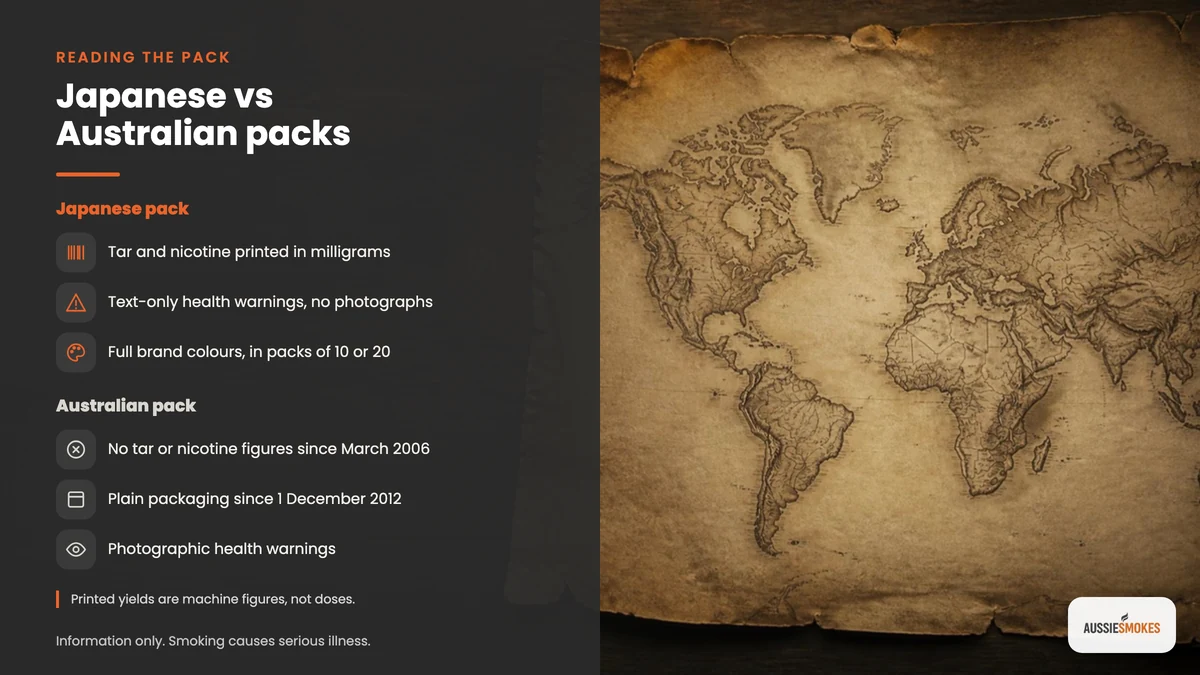
The pack is governed by the Tobacco Business Act No. 68 of 1984. Text warnings cover 30 per cent of the main faces, there are no graphic warnings, and Japan has no plain packaging, so a Japanese pack looks the way an Australian pack looked before December 2012. Tar and nicotine yields are printed on the pack, which is the single most visible difference from anything sold here. Two engineering features recur in Japanese variant names. Both alter the smoke without altering the risk. The charcoal filter, introduced by Seven Stars in 1969, adds a stage of activated carbon, while D-spec is a separate design that cuts the sidestream smoke reaching people nearby.
Two market facts affect what you can actually buy. Japanese cigarette volumes fell 52.6 per cent between 2011 and 2023, and heated tobacco took 48.5 per cent of total Japanese tobacco sales by September 2025. The range in Japan keeps shrinking as a result, which is why a variant you smoked there a few years ago has often been discontinued at source while the brand name continues on heated sticks.
The Eight Biggest Japanese Cigarette Brands, and Which Ones Reach Australia
Eight Japan Tobacco brands cover almost every Japanese cigarette an Australian is likely to see named. They run from 1 mg to 28 mg of printed tar and from plain filters to charcoal and crushable capsules, and one of them, Mevius, is the only one you can buy here without leaving the country. Each entry covers the same ground: what the brand is and how it is classified, what it prints, what it tastes like and who says so, the feature that distinguishes it, the smoker it is for, and whether it reaches Australia.
1. Mevius: the brand that used to be Mild Seven
Mevius is the same cigarette that was sold as Mild Seven from 1977 until Japan Tobacco announced the change on 8 August 2012 and switched the Japanese packs on 1 February 2013. The rename came from European restrictions on the word “mild” as a pack descriptor, not from any change to the recipe. The cigarette is an American blend with a charcoal filter, sold in king size hard packs, with Original, Sky Blue, Extra Lights, and Super Lights spread across the tar tiers. The two versions sold in Australia print 8 mg tar and 0.7 mg nicotine for the Blue, and 5 mg and 0.5 mg for the Purple Menthol.
Japan Tobacco’s own product copy describes the result of the balanced blend and the charcoal filter as a rich taste, and Japanese reviewers describe Mevius as smooth, with no rough edge, and the easiest of the Japanese brands to smoke. What sets the brand apart is its spread. One brand name covers everything from 1 mg to 12 mg, so a smoker changes tier without changing brand, which makes it the obvious first Japanese pack for anyone who does not want a jump in strength. The Purple Menthol answers a different buyer: a menthol smoker who wants the berry capsule.
The practical problem is the two names. Australian listings, travel posts, and forum threads still say Mild Seven for packs that read Mevius, so searching the old name returns nothing current. You will not find Mevius on a shelf in Australia, and no other Japanese brand can be ordered here without leaving the country. It arrives here as Japanese-specification cartons through online sellers holding stock in the country, and Aussie Smokes lists Mevius Japanese Blue at 8 mg and the capsule menthol version at 5 mg.
2. Seven Stars: the first charcoal filter
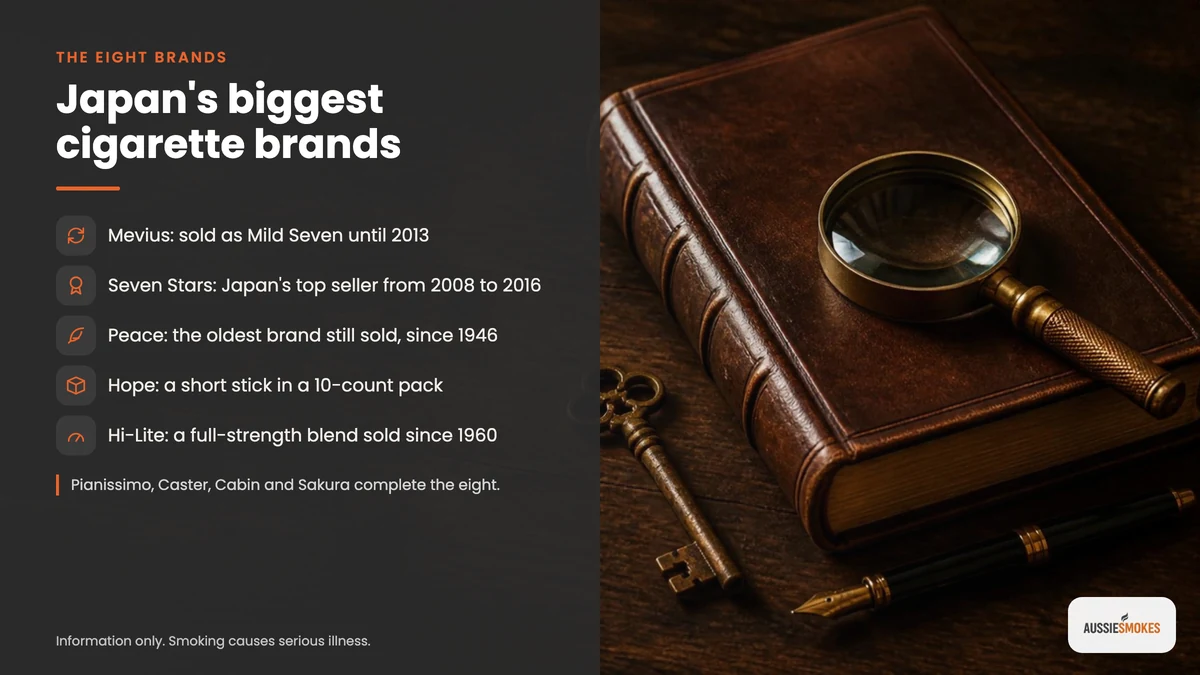
Seven Stars launched on 1 February 1969 as the first cigarette sold with a charcoal filter. It was the top selling brand in Japan from 2008 to 2016. The original prints 14 mg tar and 1.2 mg nicotine. The brand was designed around demand for lower printed yields, menthol, and reduced smoke smell. It led Japanese sales from 1975 to 1977, dropped to second when Mild Seven arrived, then returned to first place. The range runs from that original down to Seven Stars 7 at 7 mg and 0.7 mg and Seven Stars 1 at 1 mg and 0.1 mg, with menthol variants between 5 and 12 mg. Several of the early menthol and reduced-yield variants used the D-spec design.
Japanese reviewers describe the Original as heavy and sweet with a black pepper note, and retail descriptions credit the charcoal filter with the slow burn the brand is known for. The filter is the whole point of the brand. This is the pack charcoal filtration was invented for, and every other charcoal variant is still measured against it. At that tier it sits near the top of the Japanese range, which puts the buyer somewhere well past a mid-tier Australian pack.
Australian retail does not stock Seven Stars, and neither does Aussie Smokes. A small number of Australian import listings include it. The nearest charcoal-filtered option you can actually buy here is the Mevius Japanese Blue, which uses the same dual-stage design at a lower printed tier. That is a statement about availability, not a claim that the two taste alike.
3. Peace: the oldest name and the last unfiltered pack
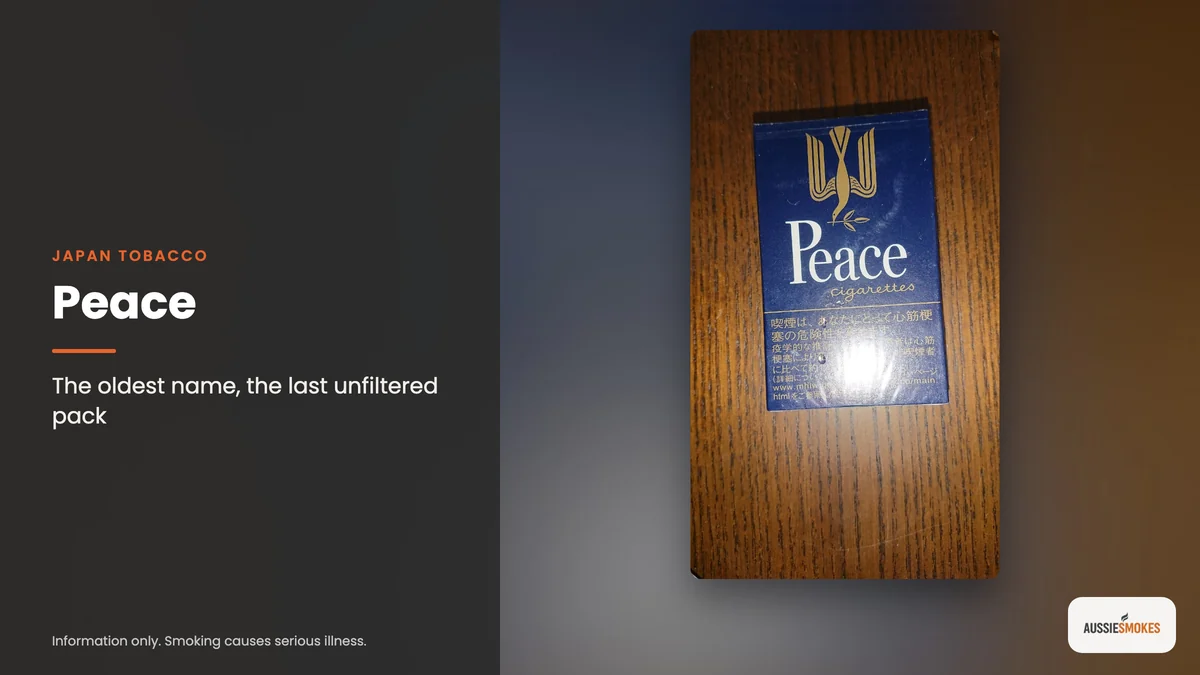
Peace has been sold since January 1946, which makes it the oldest brand still sold in Japan, and its unfiltered 70 mm version prints 28 mg tar, the highest yield of any Japanese pack on sale. Peace was launched by the Ministry of Finance monopoly authority that preceded Japan Tobacco. The dove and olive branch on the pack was redesigned in April 1952 by Raymond Loewy, the industrial designer behind the Lucky Strike pack, and annual sales went from 2.6 billion to 15 billion cigarettes after the change. Peace comes in more formats than any other brand here. The filtered 85 mm prints 21 mg, and there are 100 mm long versions plus reduced-yield variants between 6 and 10 mg. Every format is sold in soft packs, hard packs, and steel tins of 10, 20, and 50.
The encyclopedia entry describes a faintly sweet fragrance with vanilla notes. Japanese reviewers put it more usefully: honey and vanilla that only come through when the cigarette is smoked slowly, turning bitter if it is pulled hard. That dependence on pace is the character of the brand. Peace is the one brand here whose flavour varies with how you smoke it. Draw on it slowly and the sweetness arrives. Work through a pack quickly and none of it does.
Peace is the only mainstream Japanese brand still offering an unfiltered pack, and nothing in Australian retail compares, because no unfiltered cigarette at that printed yield is sold here. No Australian retailer stocks it, and it is scarce even on import listings. In Japan it competes with Hope, and outside Japan it sells mainly in Taiwan.
4. Hope: the 10-cigarette pack
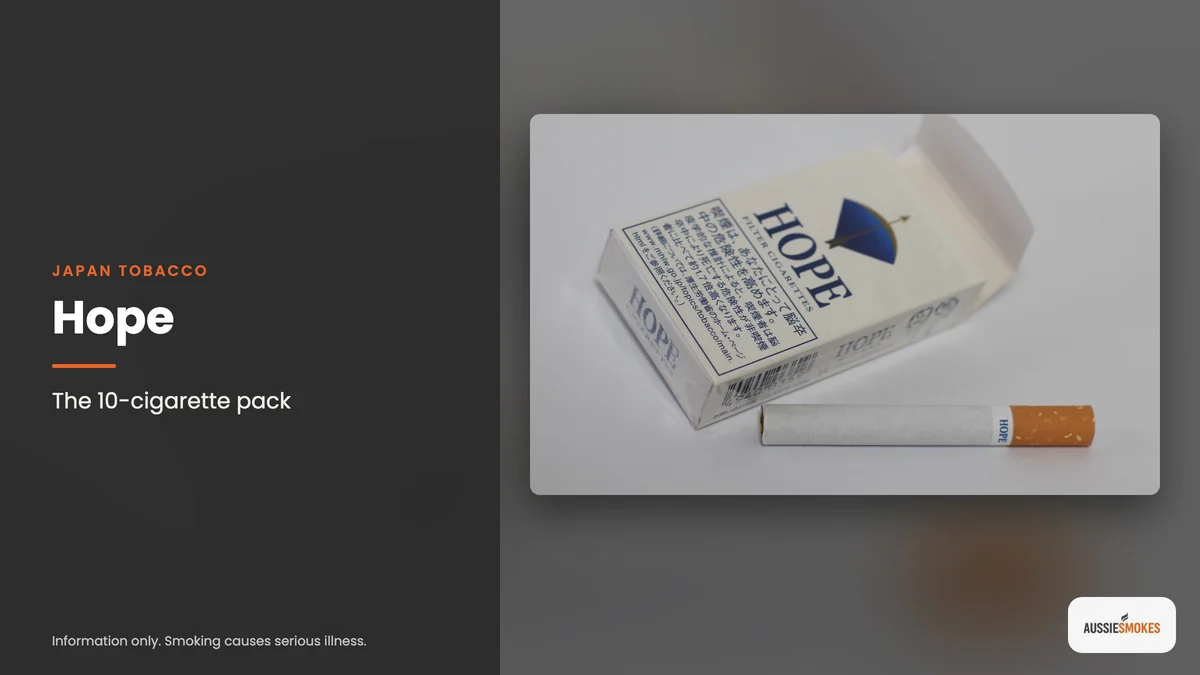
Hope launched in 1957 and is the brand most associated with the 10-cigarette pack, a format that does not exist in Australian retail because Australian law sets a minimum pack size. Some sources also credit it as Japan’s first filter cigarette, which is a separate claim from Seven Stars being the first charcoal filter in 1969, so both can stand. Japan Tobacco positions it against Peace, and the format defines it more than the blend does: a short stick in a 10-count pack. Secondary sources place the printed yields at around 14 mg tar and 1.1 mg nicotine.
Japanese reviewers describe it as short but strong and concentrated, which is the point of the format. It delivers a full-strength smoke in less time. The 10-count pack is the part worth knowing about, a size Australian smokers have never been able to buy. Anyone after a short strong cigarette is the buyer, though as many people buy it for the pack as for the tobacco.
Hope does not reach Australian retail, and Aussie Smokes does not stock it. There is also a pricing trap worth naming. A Japanese 10-pack costs roughly half what a 20-pack does, so comparing that price against an Australian carton is not comparing like with like. If you want the Australian numbers straight, see pack and carton sizes in Australia.
5. Hi-Lite: the high-tar counterexample
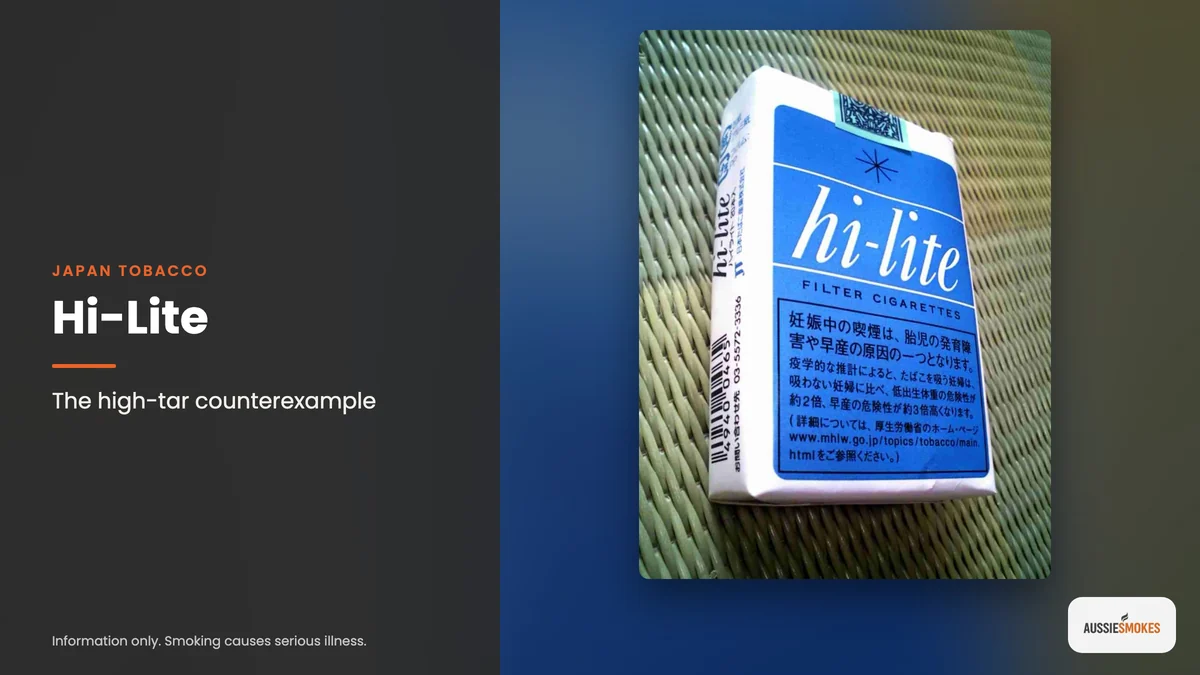
Hi-Lite has been sold since 1960 and is the brand that contradicts the idea that Japanese cigarettes all sit at the low end, with secondary sources placing its original at 17 mg. Japanese brand comparisons place it alongside Mevius, Seven Stars, and Peace. The cigarette is a plain-filter full-strength blend in a 20-count pack, and the blue pack is the recognisable one, with the oldest-looking design in the Japanese line-up. Reported yields are 17 mg tar and 1.4 mg nicotine.
Reviewer descriptions of Hi-Lite split, and the honest thing is to report both. Some report a sweet, rum-like flavour. Others report a salty first cigarette that turns bitter on the second. The printed tier distinguishes Hi-Lite more than the taste does. At that yield it is stronger than anything an Australian smoker can buy locally, which narrows the buyer to a heavy full-flavour smoker.
The Japanese range spans 1 mg to 28 mg printed, so “Japanese cigarettes are weak” describes whichever tier someone happened to pick up, not the market. An Australian choosing from an import listing on that assumption will pick wrong. The brand is absent from Australian retail and from the Aussie Smokes catalogue.
6. Pianissimo: the 1 mg tier, and all of it menthol
Pianissimo is the Japan Tobacco series made around the 1 mg tier, and every variant in it is menthol. This is where the belief that Japanese cigarettes are weak comes from. Japan Tobacco made the brand independent in June 2004, after acquiring the overseas division of RJR. The series comes in slim and flavoured formats, with Peche the best documented variant. The defining feature is the printed 1 mg yield.
Reviewers describe the smoke as thin, with menthol across every variant, and the flavoured versions such as Peche add a fruit note over the menthol. No other Japanese brand commits its entire range to menthol. A menthol smoker after the lowest printed tier in a slim format is the buyer here. Anyone stepping down from a full-flavour pack is not, and will find it thin.
A printed 1 mg is a machine yield measured on a smoking machine under a standard method. A person smoking a 1 mg cigarette does not take in a tenth of what a 10 mg cigarette delivers. Yields vary with how hard and how often a cigarette is drawn, and with the ventilation holes in the filter. The next section explains why Australian packs stopped printing these numbers at all. Australian retail does not stock Pianissimo and neither does Aussie Smokes. The nearest Australian reference point is the slim and super slim tier.
7. Caster: the mid-market line
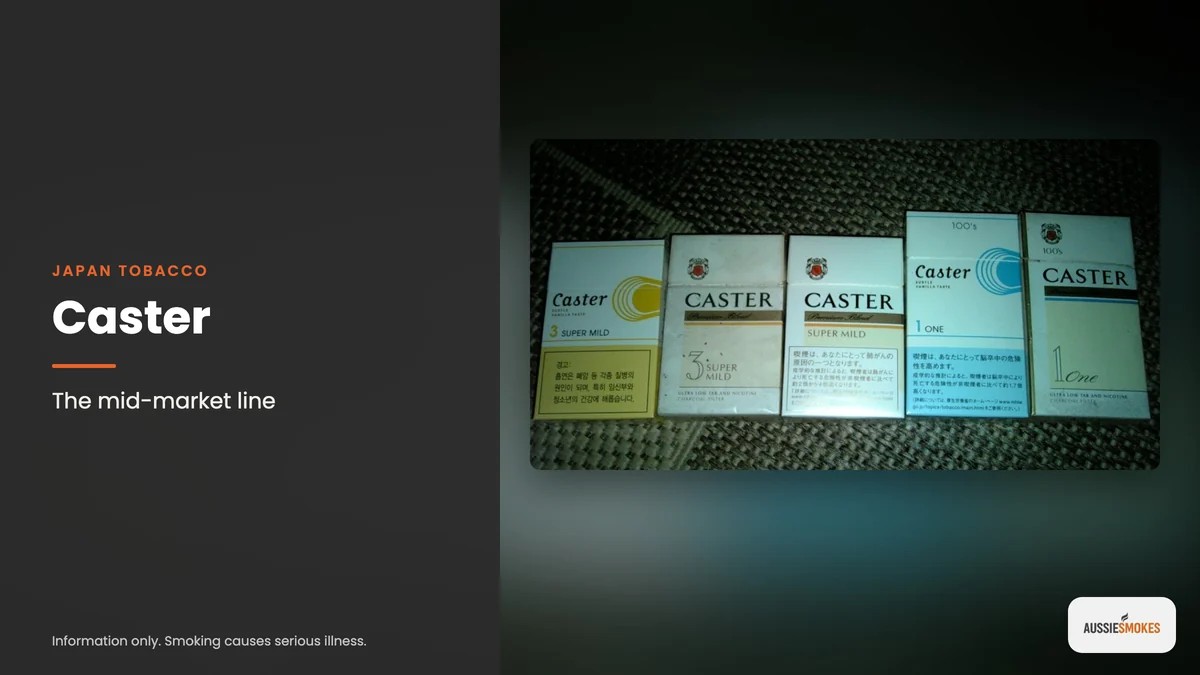
Caster is a Japan Tobacco domestic brand sitting in the mid-market, between the Mevius tiers and the older Peace and Hope brands. Beyond that placement, the sourced detail on Caster is thin. No manufacturer statement or named reviewer description of its flavour is publicly available, so none is given here.
Caster and Cabin are the two brands most likely to appear on an Australian import listing without a buyer recognising them. Japan Tobacco owns both, so a listing that presents either as a rare find is overselling. Someone who already knows Caster from Japan has a reason to look for it. Nobody else does. It reaches neither Australian retail nor the Aussie Smokes catalogue.
8. Cabin and Sakura: the remaining names
Cabin and Sakura are the two remaining Japan Tobacco domestic brands an Australian is likely to meet on an import listing. No reliable printed yields or flavour descriptions exist publicly for either, so neither is described further here. Neither reaches Australian retail, and Aussie Smokes does not stock them. That completes the eight domestic brands. The packs most Australians have actually held, though, are not domestic brands at all, and they are covered next.
Japanese-Market Packs of Marlboro, Winston and Camel
Not every Japanese pack is a Japanese brand. Marlboro, Winston, Camel, and Natural American Spirit are all sold in Japan in specifications made for that market, and these are the Japanese packs an Australian is most likely to find for sale here.
Ownership is the part that confuses people. Outside the United States, Winston, Camel, and Natural American Spirit belong to Japan Tobacco, which paid about US$5 billion for the last of the three in 2015. A Camel bought in Tokyo and a Camel bought in Texas therefore come from different companies. Marlboro in Japan is made by Philip Morris Japan.
“Japanese specification” means the pack was made for the Japanese market, which includes capsule and flavour variants never sold in Australia. Those packs print the yields on the front the same way a Japan Tobacco brand does. The yields show how wide one brand name can be. A Japanese-specification Marlboro Red prints 12 mg tar and 1.0 mg nicotine and is described by the maker as a full-flavour American blend of Virginia, Burley, and Oriental leaf. Marlboro Double Burst Japanese prints 5 mg and 0.4 mg and contains two crushable capsules, one mint and one menthol. The spread inside that single brand name is wider than the gap between most of the brands above it. Japanese smokers also describe the local Camel, Winston, and American Spirit as less full in body and more nutty than the versions sold in their home markets. For the Australian variants of the same brand, see the Marlboro variants sold in Australia, and for the crushable format on its own, see capsule menthol cigarettes.
A listing that says “Marlboro Japan” is describing the market the pack was made for. It is not a different company and not a counterfeit. The three checks are the printed yield line, the variant name, and the stick count, and the next two sections cover all three.
Which Japanese Cigarette Suits Which Smoker?
There is no single best Japanese cigarette, because the range spans 1 mg to 28 mg of printed tar and runs from plain filters to charcoal and crushable capsules. The useful question is which tier and which flavour you are after, and whether it can be bought in Australia. The table sorts on four things: the pack you smoke now, the printed tier, the flavour, and availability here. Availability is the one most listings leave out.
| If you currently smoke | Japanese equivalent | Printed tar | Flavour in one phrase | Available here |
|---|---|---|---|---|
| Unfiltered or roll-your-own | Peace 70 mm | 28 mg | Honey and vanilla when smoked slowly | Not sold in Australia |
| A full-flavour pack | Hi-Lite | 17 mg | Descriptions split: sweet and rum-like, or salty then bitter | Not sold in Australia |
| A traditional Japanese full-flavour | Seven Stars Original | 14 mg | Heavy and sweet with a black pepper note | Import listings only |
| A full-flavour pack you can actually buy | Marlboro Red Japan | 12 mg | Full-flavour American blend | Stocked |
| A mid-tier pack | Mevius Blue | 8 mg | Smooth, with no rough edge | Stocked |
| A menthol pack | Mevius Purple Menthol | 5 mg | Berry capsule over menthol | Stocked |
| A slim or super slim pack | Pianissimo | 1 mg | Thin, menthol across the whole range | Not sold in Australia |
| A short strong smoke | Hope, 10-count | Around 14 mg | Short and concentrated | Not sold in Australia |
Read the printed yield as a sorting tool and nothing more. It is a machine yield, not a measure of what a person takes in.
How to Read a Japanese Pack, and Why Your Australian Pack Has No Numbers
Four things on a Japanese pack tell you what you are holding: the printed yield line, the variant name, the filter type, and the format. The printed number is the one Australians misread, for a straightforward reason: no Australian pack has printed a tar yield since March 2006, so there is nothing local to compare it against.
The printed tar and nicotine line. Two numbers in milligrams, on the front or the side. They are machine yields measured on a smoking machine under a standard method. They are not doses, and a 1 mg cigarette does not deliver a tenth of what a 10 mg cigarette delivers to a person.
The variant name and the number inside it. Numbers in Japanese variant names such as Seven Stars 7 or Seven Stars 1 restate the tar yield. That is why one Japanese brand turns up on an Australian listing at three different strengths with no other explanation.
Charcoal, capsule, or plain. Charcoal means an activated carbon stage in the filter, introduced by Seven Stars in 1969, and it is the reason the Japanese range reads differently from an Australian one. A capsule is crushed to release menthol or fruit. D-spec targets the sidestream smoke and its smell for people nearby. None of the three is a health claim.
Format and count. King size at 84 mm is standard across the Japanese range. The 70 mm short survives on Peace and Hope, slim formats hold the menthol variants, and packs come in 10 or 20 where Australian packs do not.
The Australian half of the story explains the confusion. Yields appeared on Australian packs from 1982 and were required under Commonwealth regulation from 1994, then removed in March 2006 and replaced with qualitative information about the harmful constituents of smoke. The ACCC had found in 2005 that “light” and “mild” labelling misled buyers, and manufacturers gave undertakings to drop those terms. Plain packaging followed on 1 December 2012, taking the brand colours and logos as well. So an Australian has no pack of their own to hold the Japanese number against, and the reason it was taken off Australian packs is the same reason it should not be read as strength.
What Japanese Cigarettes Cost in Australia?
A Japanese-specification carton of 200 cigarettes sold in Australia sells for about A$220 to A$250 as at 23 September 2026, which works out at roughly $22 to $25 for the equivalent of a 20-pack. Japanese brands reach Australia as cartons of ten packs of 20, so compare by the pack. The variant drives the spread inside that band. Marlboro Red Japan sits at the bottom at $220 and the dual-capsule Marlboro Double Burst Japanese at the top at $250, with the two Mevius cartons between them at $225 and $230.
In Japan the same 20-pack of a major brand cost about ¥580 to ¥620 at convenience stores as at August 2026, with the 10-count Hope pack at about ¥300. Japanese prices are climbing in stages: a tobacco tax increase took effect on 1 April 2026, with a second stage on 1 October 2026. Tax policy explains the gap between the two countries. If you remember a cheap pack from a trip, you are remembering a different tax regime, not a different cigarette. For the Australian side of that comparison across brands, see what cigarettes cost in Australia.
Where to Buy Japanese Cigarettes in Australia?
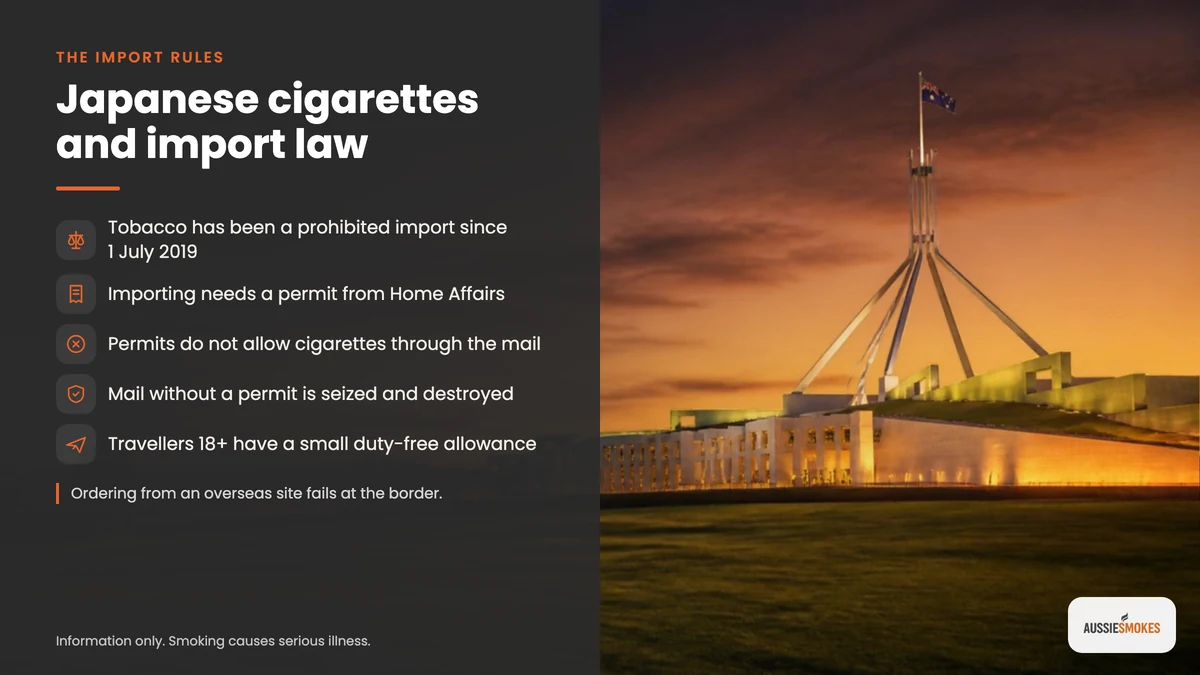
Japanese brands are not sold in Australian supermarkets or tobacconists, and tobacco has been a prohibited import since 1 July 2019. That leaves two lawful routes: an Australian seller holding stock here, or the traveller allowance when you fly home.
From 1 July 2019, most tobacco products became prohibited imports, covering cigarettes, molasses tobacco, and loose leaf. Bringing them in requires an import permit from the Department of Home Affairs. A condition of those permits is that tobacco cannot come through the mail, with a narrow exception for cigars, chewing tobacco, and oral snuff up to 1.5 kg. Tobacco arriving by international mail without a valid permit is seized and destroyed by the Australian Border Force. Ordering cigarettes from an overseas site is the route that fails, and it fails at the border rather than at checkout.
The traveller allowance is separate and narrower than most people assume. A traveller aged 18 or over may bring in one unopened packet of up to 25 cigarettes, or 25 grams of tobacco, plus one open packet, under the duty free concession. Anything above that must be declared, with duty paid on the excess.
The other route is an Australian seller. Aussie Smokes lists the two Mevius cartons alongside three Japanese-specification Marlboro cartons from the full cigarettes range. Every order is age verified, and orders placed before 1:00 pm AEST are typically dispatched the same business day from within Australia. Delivery takes 1 to 3 business days to metro addresses, 3 to 7 to regional, and longer to remote. There is no shopfront to visit in Melbourne or anywhere else.
Frequently Asked Questions
Can you buy Japanese cigarettes in Australia?
Some of them, from Australian sellers holding stock here, but not from an overseas site. Mevius and Japanese-specification Marlboro cartons are listed by Australian online sellers. Most Japan Tobacco domestic brands, including Seven Stars, Peace, Hope, Hi-Lite, and Pianissimo, are not sold here at all. Tobacco is a prohibited import without a permit and cigarettes cannot come by mail, so an international order is liable to seizure.
Are Japanese cigarettes stronger or weaker than Australian ones?
There is no single answer. The Japanese range runs from 1 mg printed tar on Pianissimo to 28 mg on an unfiltered Peace, while Australian packs print no yield at all and have not since 2006. Those printed yields are machine measurements and do not measure what a person takes in, so they are useful for sorting variants and useless for comparing countries.
