
Brand


Tobacco Strength Guide: Taste, Throat Feel and Nicotine Delivery
A tobacco strength guide for Australia explains what adult smokers mean by full, medium or mild cigarettes when packs carry no official strength rating. Strength in everyday speech is taste, throat feel and nicotine delivery from the blend and how the stick is smoked.
Legacy Red, Blue and Gold cues are informal taste shorthand; adults compare by blend and draw, and menthol or capsule coolness is felt, not lower nicotine or a safer product.
What Does Cigarette Strength Mean?
Cigarette strength in everyday speech usually means how full the tobacco tastes and how hard it hits the throat, not a government score for nicotine or safety.
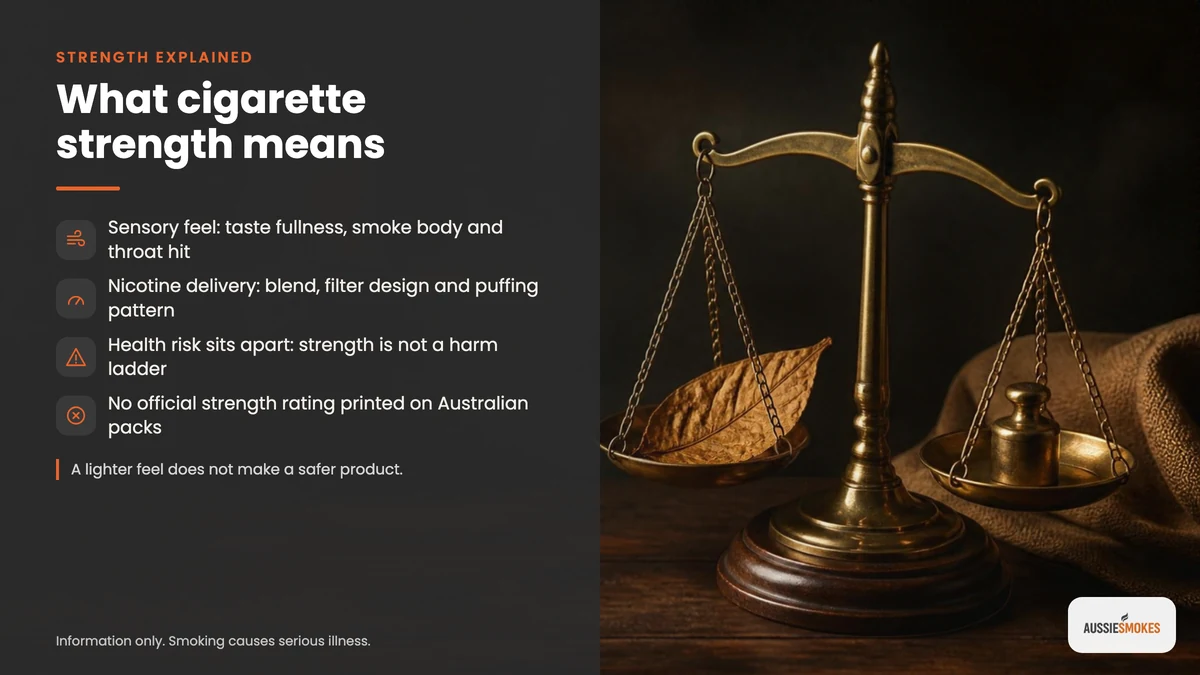
That everyday meaning usually stacks three things together. Sensory feel covers taste fullness, smoke body, and whether the throat feels harsh or smooth. Adults often call a stick mild when the draw feels gentler and the smoke tastes lighter. They call a stick full when the smoke feels denser, the tobacco taste is more assertive, and the throat hit is harder. Menthol coolness or a capsule burst can change that sensory picture without changing the underlying tobacco dose.
Nicotine delivery is how much nicotine reaches the smoker from the tobacco blend, the filter design, and the puffing pattern. Australian retail packs do not print an official nicotine strength score today. Delivery is judged by experience: how quickly the first few puffs satisfy, how long the effect lasts, and whether the stick feels underdone or overdone for that adult’s tolerance. Two adults can smoke the same variant and report different delivery if one puffs harder or more often.
Health risk sits apart from both. Strength speech is not a government harm ladder. All smoked tobacco remains harmful and addictive. A lighter feel does not make a safer product. Australian public health policy stripped descriptive strength claims because milder branding was read as lower risk when disease burden did not fall in step.
Australian packs still carry no official full, medium or mild rating. Adults lean on speech tiers, remembered machine numbers, and legacy Red, Blue and Gold name cues when they talk about strength. The sections below keep those words useful without mistaking them for a safety score.
Full, medium and mild: how strength tiers are described
Adults still sort cigarettes into mild, medium and full (or strong) tiers from older labelling habits, even though Australian packs carry no official strength rating.
| Tier | Typical taste / throat feel | Nicotine feel | Notes for adults 18+ |
|---|---|---|---|
| Mild | Gentler taste; smoother throat | Lower perceived kick | Often chosen for a smoother draw. Not a safer product. |
| Medium | Balanced body; moderate throat hit | Noticeable, comfortable kick | Everyday in the middle of the speech scale. |
| Strong / Full | Fuller taste; harder throat hit | Higher perceived nicotine delivery | Experienced adults only in speech terms. Still not a harm rating. |
Mild sits at the gentlest end of the speech scale. Many adults pick it when they want less throat punch, which is a comfort choice, not harm reduction. Medium is the everyday middle: balanced body, clear but manageable kick. Strong or full means denser taste and a harder hit, and it is still only a speech label.
Light and mild names were restricted as misleading after ACCC action against tobacco companies. Undertakings required those descriptors and related number cues to go because they were likely to suggest health benefits that machine yields and real smoking behaviour did not support. Full-flavour talk left in conversation is taste shorthand, not a government category.
No tier is safer. Deeper or more frequent puffs can wipe out an intended mild feel. These tiers are for adults aged 18 years and over only. They help compare sensory expectations; they do not rank products by disease risk.
Nicotine, tar and machine yields (what the numbers meant)
Machine-tested tar, nicotine and carbon monoxide yields once appeared on Australian cigarette packs as average smoke contents under fixed laboratory puffing conditions.

Those numbers were ISO-style smoking-machine readings sorted into nominal tar bands such as 1 mg, 4 mg, 8 mg, 12 mg or 16 mg or less. They described what a machine recorded under set puff volume, duration and interval. They did not describe what a person actually takes in when puffing harder, longer or more often, or when covering filter vents. They were not a health ranking. They did not prove that low-yield sticks were safer.
Tobacco in Australia chapter 12.9 records that on-pack tar, nicotine and carbon monoxide figures were replaced from March 2006 with qualitative information about harmful smoke constituents under new health warnings. That closed a long stretch when side-of-pack numbers and light or mild words shaped how adults sorted brands into strength tiers.
The ACCC had already treated light, mild and related number descriptors as likely misleading. Smokers can compensate by changing how they smoke and still take in higher yields than the machine suggested. Undertakings from major manufacturers removed those descriptors and funded consumer education that low-yield brands were not likely to offer health benefits compared with higher-yield brands.
Without printed yields on the pack, adults fall back on speech tiers and legacy name cues. Remembered milligram numbers from older packs are labelling history, not a current strength meter and not a safety score.
Red, Blue, Gold and other legacy strength cues
Red, Blue and Gold survive in adult speech as informal taste shorthand, not as an official strength rating printed on Australian packs.
In everyday talk, Red or darker names often map to a fuller taste, Blue or mid names to a medium feel, and Gold or lighter names to a smoother or milder draw. That map is a habit, not a regulated scale. Brand families kept colour words and soft descriptors after light and mild were restricted, so the speech stuck even when legal labelling changed.
Under plain packaging, pack bodies use a standardised drab colour. Red, Blue and Gold are legacy or variant name cues in speech and older naming. They are not coloured pack bodies that signal strength. Reading a drab plain pack as if its body colour graded nicotine is a common commercial myth, and it does not match how Australian packs are designed under plain packaging rules.
Department of Health tobacco-changes material notes that words such as smooth and names such as gold, which can falsely suggest some products are less harmful, are removed from product naming. Those 2025 naming rules sit alongside bans on menthol flavours and crush-ball accessories that masked harshness. The policy goal is clearer risk communication, not a quieter strength ladder.
Informal cues do not prove lower nicotine and do not mark a safer product. All smoked tobacco remains harmful and addictive. Treat Red, Blue and Gold as conversation shorthand while you compare blend and draw for yourself.
How adults compare strength in practice
With no official strength rating on the pack, adults compare cigarettes by tobacco blend and how they draw, not by a printed mild-to-full score.
Blend is the leaf mix and how it was cured. Virginia-dominant mixes often taste sweeter or brighter. Burley-heavy mixes can taste nuttier and feel denser. Oriental or other component leaves change aroma and throat character. The blend recipe is the main legal variable left once packaging and flavour rules standardised much of the stick appearance. Fullness of taste and throat punch usually track the blend more closely than any leftover colour name.
Draw is puff depth, frequency, and how much of the stick is smoked. A harder draw can raise nicotine delivery and make a stick feel stronger even when the informal tier sounds mild. Leaving a longer butt, taking shorter puffs, or smoking fewer sticks in a session can soften perceived strength. Those behaviour changes also change intake. They do not turn smoking into a safe activity.
Menthol or capsule coolness changes sensory feel. Coolness is not proof of lower nicotine and is not a safer product. From 1 July 2025, menthol flavours and crush-ball accessories that mask harshness were banned under Australia’s tobacco product changes. Adults who relied on coolness as a mildness cue need to recalibrate: coolness was feel, never a dose label.
Compare small quantities before committing to a carton. Note which blend and draw pattern felt right, then buy that pattern again instead of chasing colour names that no longer work as strength signals on the pack. Treat mild, medium and full as personal taste maps, not brand promises. Watch the first three puffs, how the throat sits mid-stick, and whether you start puffing harder to chase satisfaction. No cigarette is a safe option. If chasing a stronger feel marks rising dependence, seek quit support (details in the responsible notes below).
How to choose a strength
Choose by nicotine tolerance and format experience, not by marketing body language alone. The paths below are for adults 18 years and over. How to choose tobacco strength sits in three practical paths: adults new to a format, stepping from Strong to Mild, and cigarette smokers moving to RYO. No tier is safe.
Adults new to a format (avoid nicotine sickness)
Adults new to a format should start lower on the everyday speech scale, typically mild or medium, until they know how that product hits. Nicotine is something you feel. Strength here means how strongly you feel that nicotine, not how spicy or flavourful the smoke tastes. Too much can bring nausea, light-headedness or dizziness. Eat first, stay hydrated, and do not chase an early buzz with harder draws or lighting again too soon. Cigarette smoke is generally inhaled into the lungs, while some other formats deliver nicotine through mouth tissues even without deep inhalation, so the same speech tier can feel different across formats. Start gently, note the first few sessions, and only step up if the milder end still feels underdone. This path is for adults 18 years and over only.
Stepping down from Strong to Mild
Moving from Strong or Full toward Mild can change taste and throat feel. It does not make smoking safer. Deeper or more frequent puffs can erase the intended mildness, so the step-down may not reduce intake the way the speech labels suggest. No tobacco product or level of smoking is a safe option. If the real goal is harm reduction, not just a softer draw, seek quit support instead of trading tiers. Quitline details sit in the responsible notes below.
Cigarette smokers moving to RYO
Switching from factory cigarettes to roll-your-own is a format change, not an automatic strength match. RYO feel depends on the blend, the cut, how densely the tobacco is packed, and the paper used. A cigarette smoker who rolls a dense stick of a fuller blend can feel a harder hit than the mild factory variant they left behind. Nicotine delivery also shifts with how the smoke is taken, so treat early sessions as calibration. Start with small packs while you learn how your roll behaves, before committing to a large pouch on the first try. Roll-your-own is not a safer product. All smoked tobacco remains harmful and addictive.
FAQ
Felt strength can still diverge from the everyday mild-to-full label once real smoking behaviour and older labelling habits enter the picture.
Can deeper or more frequent puffs make a milder cigarette feel as strong as a full one?
Yes. Deeper, longer or more frequent puffs can raise nicotine and tar intake from a stick adults call mild, so the felt strength can approach a fuller product. Machine yields assumed fixed laboratory puffs. Real smokers adjust. Covering filter vents or smoking closer to the butt can also lift intake. A milder feel in speech does not lock intake to a lower dose.
Do crush-ball or menthol capsules reduce nicotine, or only change coolness and flavour?
Capsules and menthol change coolness and flavour feel. They do not make a cigarette lower in nicotine or safer. From 1 July 2025, menthol flavours and crush-ball accessories that mask harshness were banned under Australia’s tobacco product changes. Recalling an older capsule stick as mild because it felt cool confuses sensory masking with dose.
Do remembered milligram numbers from old packs still predict how strong a cigarette feels today?
No. Machine yields left Australian retail packs from March 2006 and never matched real smoker intake under compensation. Memory of old milligram bands is labelling history, not a present strength meter. Two sticks that once shared a printed band can still feel different today because blend and draw dominate the experience.
Responsible notes and Quitline
This article is for adults aged 18 years and over only. All smoked tobacco remains harmful and addictive. No mild, medium or full tier is a harm-reduction product. A lighter feel is not a safer cigarette. Informal Red, Blue or Gold cues and remembered milligram numbers do not change that fact.
If you want help to quit smoking or vaping, call Quitline on 13 7848. Counsellors offer confidential, evidence-based support, including help with triggers, cravings and a quit plan. Aboriginal Quitline support is available for Aboriginal and Torres Strait Islander people. People with a hearing or speech impairment can use the National Relay Service, and interpreter options are available for languages other than English.
